

(Note: this essay is the final in a series.)
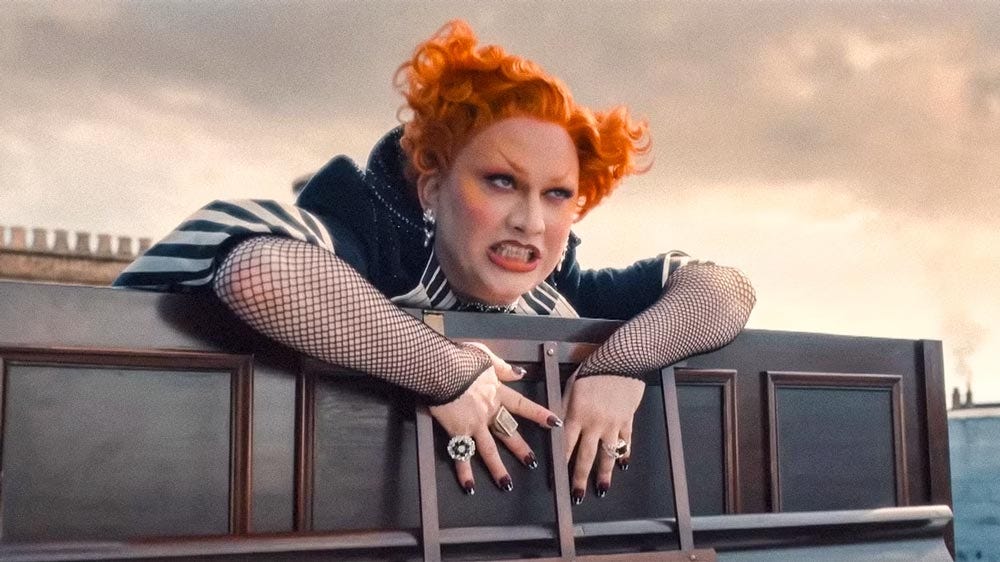
The RTD2 era of Doctor Who is surely among the greatest fiascos in modern television. Russell T Davies had plenty of time, plenty of money, plenty of talent, and plenty of writers both accomplished and waiting in the wings ready to churn out good scripts. In theory it should have been a triumph. Instead it was a catastrophe on every level.
Exactly how this occurred is a question that vexes many. The scale of it is hard to believe. Right-wingers want to blame state funding (BBC), but Disney was involved. Left-wingers want to blame capitalism, but state funding was involved. Of course, both could be right simultaneously; everything the socialised BBC makes nowadays is awful, everything the capitalistic Disney makes nowadays is awful, so it’s hardly surprising when a co-production between them is awful.
However, given the nature of this particular production deal, it seems that neither state funding nor capitalism was responsible. The culprit wasn’t the BBC or Disney, but Russell T Davies himself. This makes sense given our earlier review of his career, and given that, on this project, he seems to have enjoyed total freedom. If this Times article is accurate (and it has never been refuted) then the BBC could not veto a single decision that Davies took; he had made sure of it. If the claimed insider account from America is accurate, he simply refused to listen to Disney’s feedback.
So how did it happen?
Three factors were involved: Davies’ total creative autonomy, his arrogance, and his paranoia.
His autonomy
He was able to get total autonomy because of his huge stature in the industry, because the BBC were desperate to rescue Doctor Who after the Chris Chibnall era, and because he was the only person they trusted to do it. Nobody else even volunteered except for J Michael Straczynski. Unlike him, Davies was a known quantity, and the BBC had become very risk-averse. Also he agreed with them - unsurprisingly, since he had persuaded them of it in the first place - that Doctor Who should go big budget. For all these reasons, the choice to put him in charge was a “no brainer”. From the BBC’s point of view, and Disney’s, it must have looked like a surefire success. One can imagine them thinking they should “just leave the genius alone to work his magic”.
His arrogance
This is simply explained by his continued success in a TV industry that, in tandem with his career, had become more and more lightweight, sensationalist and female-minded, exactly his style of writing. The industry grew towards his style, so that he became ever more the “flavour of the month”. No matter how silly or shallow his writing became, he kept getting rewarded for it. By 2022 he probably genuinely felt he could do no wrong; it had been decades since anybody had said “no” to him. This meant he no longer checked his work, in any way, and didn’t feel a need to take seriously any criticism of it from other people - even from those funding him.
His paranoia
He had always been paranoid, but I think the 2010s culminating with the Summer of Floyd and the “peak woke” of the Biden presidency probably gave him a brief taste of calm. It was ten years of non-stop progressive social revolution, so he probably thought the rainbow would reign forever. But then this assurance was destroyed by Musk buying Twitter in 2022, and in 2023 the rise of Reform UK, the 2024 re-electing of Trump, the Gaza genocide and the unravelling of the trans craze. This explains why RTD2’s societal norm is supreme wokery - happy-clappy, ultra-progressive, everyone race-mixing, almost nobody straight or cisgender - but it is peppered with foreboding and dire warnings about social media, bigotry, misogyny, pro-family influencers, and right-wing demagogues. Davies was too old, too arrogant and too well-connected to wonder whether he had been wrong about any of these things, so his inevitable choice was to pillory them in his writing.
So it was a perfect storm. The BBC were bound to give him carte blanche and he was bound to create a disaster with it.
Wokery is not something Davies does just because it is fashionable; it is an obsession that has dominated his life and defined his career. He was doing this kind of thing long before it became standard and will be doing it long after it becomes passé. He will be like the stranded Japanese soldier still fighting WW2 decades later because he never “got the memo”.
Fittingly for a trailblazer, Davies takes wokery farther than anyone else. With an “OG” like him, someone who has a genuine grievance against historical limits rather than just a fashionable disdain, it’s as if we are returning to “the source” and getting a purer attitude than can be mimicked forty years later by some teenager on a Gender Studies degree. This is Boomer original, not Zoomer emulation.
But that “pure attitude” is not only resentment. It does not spring merely from coming of age in 1970s Welsh schools where boorish boys beat up fledgling “poofs”. It is an outlook that is bolstered by academia and approved by the culture at large, which transmits it via Marc Bolan, Dennis Potter, Joe Orton, Quentin Crisp, Oscar Wilde… It is enabled by a century of deconstruction, material comfort, and individualism.
I could outline this “pure attitude”, but Davies does it for me. Here he is describing the Doctor, as he conceptualised him in the RTD2 era:
[He] just goes anywhere for no reason. It’s not his job, it’s not his mission, it’s not his task, it’s not a quest, he just pops off to the next place at random, and that is joyously freewheeling.
But before RTD2 it was the Doctor’s mission to explore the Universe and help people. It was his task to defeat injustice. In RTD2, Davies has him do exactly the same things as before, but without the prior sense of purpose or in-born mandate. In theory, then, the Doctor could just stop all of this one day and open a boutique or some other random thing. But that is a lie, because no creature is free from its own nature.
Davies had the Doctor describe himself similarly in Space Babies:
I don’t have a people. I don’t have a home. But I don’t have a job either. I don’t have a boss, or taxes, or rent, or bills to pay. I don’t have a purpose, or a cause or a mission. But I have freedom. That’s why I keep moving on - to see the next thing, and the next, and the next.
But it was his cause to put things right. He didn’t keep moving on simply to find the next meaningless novelty; it was his purpose, his raison d’etre, to help other beings and put things right. He was an explorer, yes, but not a tourist.
Davies’ new version represents the end point of liberalism: to be entirely without attachment, dependants, duties, obligations or limitations; to be without either a boss or a god, any higher order that might curtail one’s choices; to be infinitely free - free to experience countless novelties. It is the end point of consumerist materialism, but also the end point of woke transhumanism.
Davies thinks this is exciting and “joyous”. But ordinary people don’t want to be free to the point of aimlessness. They need duty and purpose. For the main character in a drama, no less, to be absolutely free is not inspiring at all; it is deadening, even depressing.
Since his (new) description of the Doctor was not even accurate, Davies was really crowbarring it in. He clearly had a reason that was outside the show. It’s how he would like the Doctor to be, just as he would like everyone to be gay, or trans, or bi, or at least be absolutely fine with it - the collapsing of all categories, the erasure of all limits. But this is antithetical to humanity, and his characterisation of the Doctor was antithetical to the show.
So, too, was the genre shift towards fantasy. The reason was the same (to escape the limits of science-fiction) and the effect was the same (to remove tension from the show since it no longer had to make sense or be consistent).
I think Davies’ stature in the TV industry has been diminished. Because of his lust for doing interviews, he is now publicly associated with a hugely expensive show that was widely hated. Who would have him overseeing any big project now? I think, as he threw Gatwa under the bus, his colleagues and rivals might do the same - or worse - to him, with him ending up as the fall guy for this disaster, while all the media executives who egged him on appear spotless.
And that, really, is the sick part. Davies has made a fool of himself, but who led him to do that? Who never urged caution or held him back? Who encouraged him every step of the way, and applauded every little piece of subversion he laid upon the British public?
Russell T Davies is a damaged man who, in a better age, would have been discouraged by his peers and bosses from indulging that chip on his shoulder, and instead encouraged to look inside himself and recycle his anguish into something good, healthy, positive and nourishing - something true, something worthy of his considerable talents. Instead, he was encouraged to make a fetish and a lifestyle and a crusade out of opposing the mainstream, hating heteronormativity, demonising fathers, twisting characters (including Shakespearean characters and even Shakespeare himself!) and assaulting the standards upon which society depends. For doing this, he was showered with awards, accolades, recognition, and money. It is all blowing up now, and I suspect he will be left alone in his house with his Baftas, wondering when the phone is going to ring.
But perhaps the most tragic thing is that Davies, an intelligent man, will be stultified by his prejudices and therefore won’t learn from this experience. Instead, he will interpret the ratings sink as proof that the British public are homophobic, despite their façades, and he was right all along! In actuality, if he had just kept his expectations as they were in 2005, the public would be less anti-gay now, and he would be the queen of the world again.
What the colossal failure of RTD2 means for Doctor Who itself is not encouraging.
Independent companies will make tenders for the contract to produce it, but it might well be that none can find a way to produce what the BBC now want (a globally-competitive sci-fi show) on the budget the BBC can raise on their own.
If this is so, then the BBC will have to go cap in hand to the US streamers again, and might end up having to dance to the tune of Amazon, Paramount or Netflix. These would inevitably demand more creative control than Disney had, which would further remove the show from its roots both in British sensibility and in low budget.
However, that might be the only way forward for a BBC that believes Doctor Who must never be a charming little cult TV show again.
And, since that belief - which has crippled and doomed Doctor Who - was established by Russell T Davies himself in 2005, it could be said that he has destroyed it in a more insidious way than the obvious. In 2024 he stated:
The BBC thought the show deserved to look as good as Stranger Things, as the Star Wars shows. Why should we be the humble little show being made in a shoe cupboard?
Because that is exactly what gave Doctor Who its charm. It was a British show, with a British budget, making a virtue of simplicity, not even trying to compete with American fare but instead just “doing its own thing”. This resulted in a quaint, cosy and unique show that people loved.
A more secure man than Davies, a more sensible man, might have understood this and told the BBC not to corrupt Doctor Who by forcing it to compete on the global stage. But, in 2005 and ever since, Davies advocated exactly that - even though it would surely kill the thing he loved.
In the meantime he has corrupted it in many other ways, catalogued in this series. Corrupting seems to be what he does best. He has done it since first getting any power in television in 1993, and since then, the more power he has gained, the more he has corrupted whatever was under his control. He is a man who, unrestrained by others, can only corrupt.
This is because he is consumed by loathing - of the healthy, the traditional, heterosexuality, hierarchy, reproduction, nationhood, rootedness, truth, honesty, and above all, himself. He is a man who never fitted into his society but never had the humility to make peace with it, so instead worked against it and attempted to weaken it so that it could no longer threaten him. As a result, he lives in constant fear of a reversal, of healthy order finding a way to reassert itself, and so again, he must do everything he can to prevent this from ever happening. It is a vicious spiral, propelled by his own lack of self-knowledge. As such, he is doomed to embody corruption - harming the society that created him and the things he loves.
One of the ways in which Davies had always wanted to differentiate modern Who from classic Who was by showing more of the characters’ emotions and relationships. Aside from romantic liaisons, this means familial relations - siblings, parents, children. Science-fiction opens the door for all sorts of things to affect such relationships. But, in RTD2, characters are hollow and family is almost always a disjointed, unconventional or bizarre affair. Unfortunately, when sci-fi elements hit characters and relationships that don’t “ring true”, the effect falls flat.
Davies, in planning RTD2, might have chosen his writers based on their unlikelihood to be parents:
The result is a dearth of normal White families in RTD2. Across the 21 episodes, only two are seen: one is barely glimpsed, the other is immediately wiped out.
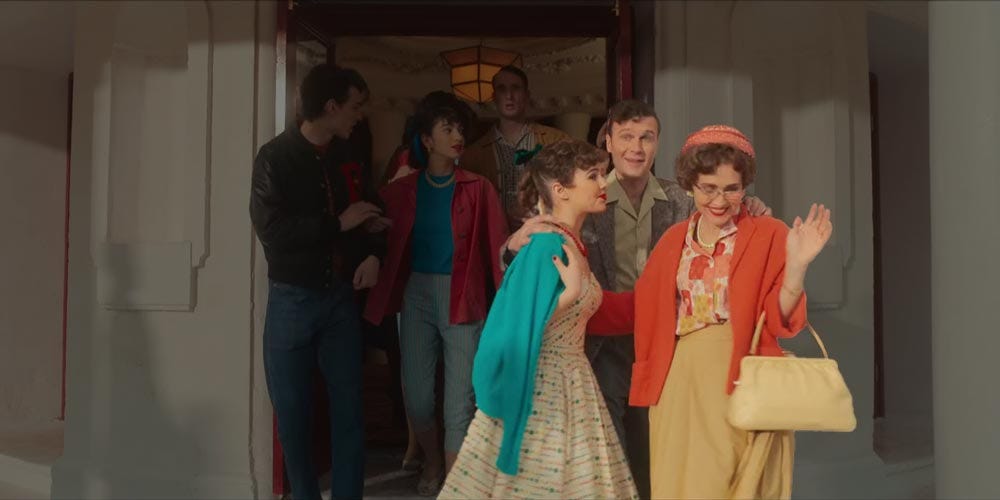
The first is in Lux. They have no dialogue and appear so briefly (two seconds) that most viewers will not even notice them:
The second is in Wish World, a 19th Century Bavarian family with seven children. They are destroyed in the first scene (by a powerful Indian woman). Written by Davies, this seems almost like a calculated mockery of family, an attack on the idea of family as a source of protection, security and stability.
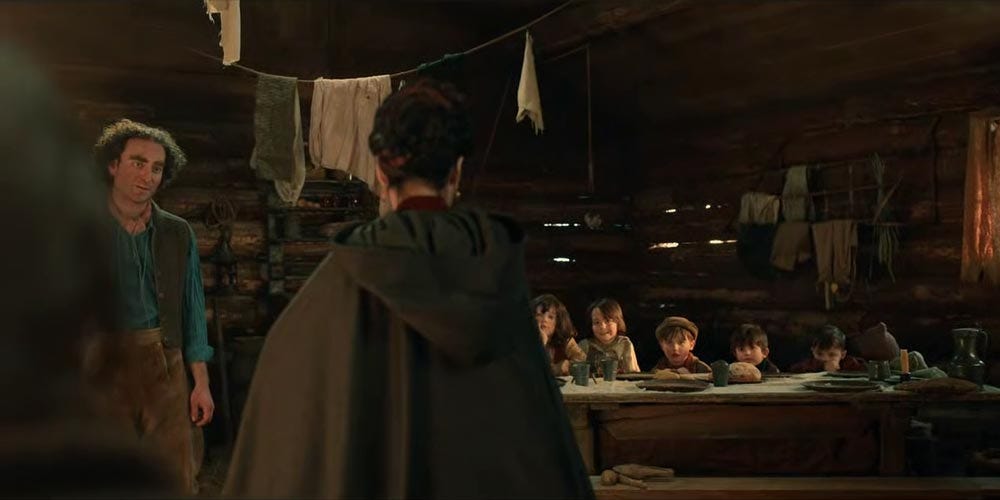
It’s also worth saying that the actor playing the father, Atilla Akinci, is not White as such, but Turkish. He certainly doesn’t look like a 19th Century Bavarian! Apparently the casting agent just couldn’t find a more suitable actor, in all of Germany.
This is ostensibly the one proper depiction of an intact White family in RTD2, but even here, they couldn’t bring themselves to actually depict a White family.
What this means is that, in the 21 episodes of RTD2 (1040 minutes), you see an intact White family for precisely two seconds.
All other families shown are non-intact or non-conventional:
transgender mixed-race Rose with her widowed White mother
White Ruby with her Black lesbian stepmother
the titular characters in Space Babies, conceived artificially and reared by a Black pseudo-mother
Wish World shows the Doctor and Belinda married with a daughter, but all three characters are non-white and in any case the situation is a fantasy delusion
We see an astonishing eight White single mothers:
in Dot and Bubble we see a photo of Lindy’s mother. (Of course, there is no mention of her father.)
a widowed mother in Empire of Dust. Bizarrely, even when the father has supposedly been resurrected and the family should be back together, he is still not shown, only the woman and child. Considering the fortunes spent on special effects in this episode and the tiny cost of hiring an actor for a momentary non-speaking part, the absence of the father here is simply inscrutable.
in Empire of Dust, Ruby finds the mother who abandoned her as a baby
Joy’s (apparently) single mother in Joy to the World
a (apparently) single mother in Lux. She is worried about her son who has gone missing. Despite this, and despite living in hyper-conservative 1950s small-town America, she makes no mention of his father!
Lux also shows another mother with child, both non-speaking
Aliss in The Well, who is raising her daughter with her own (unseen) father
Conrad’s abusive single mother in Lucky Day
The situation with fathers is even worse. Only four are seen in the entirety of RTD2:
the barely-glimpsed White father in Lux
the (Turkish) Bavarian farmer in Wish World
the fantasy of the (Black) Doctor having a daughter
Vater in Boom (see below)
Like the (Turkish) Bavarian farmer, Vater is killed before the opening titles begin. It is almost as if Davies wants the child viewer to have no faith whatsoever, not just in the nuclear family, but in fathers. He has long had a penchant for depicting fathers as cruel, selfish, irresponsible, homophobic, bullying, or else deceased. In fact, his story arc for Season 1 (about Ruby being a foundling) provided an ideal opportunity to look at the other side of things - the important and unique role of one’s father in one’s life - but Ruby oddly has no interest whatsoever in her father, only her mother. Bizarrely, her father is never even mentioned until the final episode, and then only briefly (and not depicted, unlike the mother).
Against a backdrop of unusual, broken, mixed-race or perverse parent-child relationships in RTD2, two episodes stand in stark contrast.
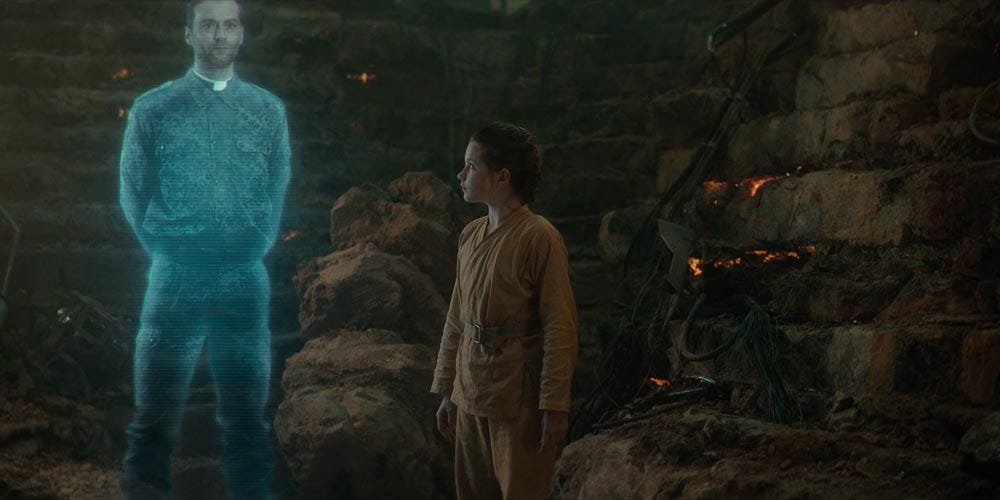
Boom prominently features a father and daughter. Vater and Splice are both White, Christian, straight and “cisgender”. What’s more, they are devoted to each other. We see attachment, tenderness, laughter and love between them, and the responsibility that each has towards the other. We can easily believe that these two characters are related, know each other very well, and love each other.
Vater and Splice are unique but they represent a form that we are familiar with. While watching them we can refer to that form, and see it perhaps countered by some of their quirks, but ultimately and beautifully affirmed - a social norm renewed, to the benefit of society and the vast majority of people.
As a viewer of RTD2, bombarded with a panoply of gays, transgenders, race-mixers, childless adults, parentless children, mechanically-gestated children, and other baffling edge-cases, it is so nice to finally see this healthy and life-affirming thing: a father loving his daughter, a daughter loving her daddy. The feeling is one of great relief - “Oh yes, normality…”
There is one other parent-child relationship that rings true. It is in the episode Joy to the World. Joy is an unhappy young woman, full of self-doubt, and not conventionally attractive. The closest person to her was her mother, who died four years ago. Joy carries guilt for not being with her mother in her final days, due to COVID restrictions. Joy is full of love, but she hates herself. She puts on a brave face for the world, trying to seem happy, but she is lost and hopeless, and thinks badly of herself. Yet her mother loved her dearly.
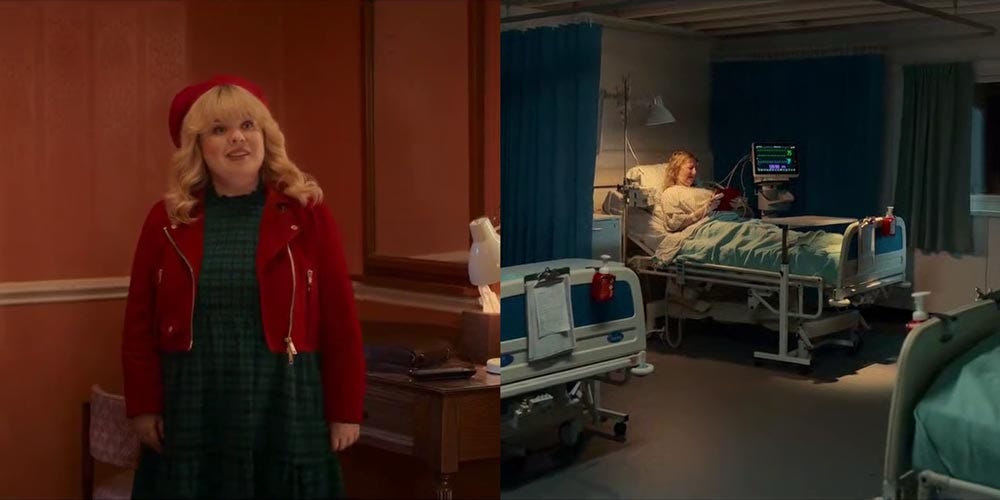
We never even see these two characters together, but the way their relationship is painted is incredibly persuasive and touching. It feels like the work of somebody who has been a parent and observed his friends being parents, somebody who has seen the dynamics involved and contemplated the facets of family - devotion, belonging, obligation, overwhelming gratitude.
While every other parent-child relationship in RTD2 feels “somehow wrong” - artificial, contrived, or just bizarre - and impossible to believe in, these two ring true. It warms the heart, and reminds us of what the vast majority of us should be doing: not seeking endless novelty, but creating heterosexual families and becoming parents.
The episodes Boom and Joy to the World were both written by Steven Moffat. They happen to be among only three episodes of the 21 written by a heterosexual and the only two written by a parent. Moffat is a White, sixty-something family man. How many men like that get TV scripts commissioned nowadays? I believe it only happened here because Moffat is a previous showrunner. Without his two episodes, RTD2 would have been entirely devoid of convincing parent-child relationships.
But it has to be said that, even in Moffat’s episodes, both of the families are single-parent. Worse still, when Splice’s only remaining parent dies, she is adopted - by an Indian woman. Why? Why couldn’t her mother be alive, and rescue her at the end? The storyline in no way requires that the mother be dead, it is already bad enough for the girl to lose her father, and it would be, after all, more likely and plausible for the mother to be alive… so why did she have to be dead, so that a little White girl could be adopted by an Indian and a White family be replaced by an inter-racial family?
The answer is that normal families and relationships simply aren’t welcome in RTD2. Moffat’s natural tendency was to include them. Davies’ natural tendency was to vastly drown them out with single parents, abandoned children, race-mixing and sexual deviance.
This is Russell T Davies’ world. This is the end stage of liberalism: freedom, but barrenness.
When he speaks of joy, I believe it is self-delusion.
It’s a lot of work, joy. It’s very hard to achieve on screen. Anyone can cry in the rain. Sadness is comparatively easy: thunder, it rains, cry, that’s all done. I believe in reaching and pushing for the greatest emotions that you can possibly get. Pushing towards joy.
The trouble is that, in drama, joy only matters if it is worked for. Otherwise, it feels meaningless - a smiling face pasted over a hollow interior. This is how “joy” feels in Davies’ second tenure: fake, shallow, unearned, cheap, sickly sweet. The Doctor is forever talking about joy and looking joyous, but never do we see him earning his joy with struggle. We do see him running away from responsibility quite a few times, though. We see him reduced to crying in almost every episode - a fragile emotional wreck. He is an indulgent, selfish, weak, decadent, vain, irresponsible and cowardly character without any backbone or sense of duty.
With that in mind, let us return to that quote from the Sisterhood of Karn’s founder:
Gay people are more in touch with their childhood than straight people - they don’t have to go through the processes of marriage, mortgages, kids. However old we are, we don’t feel the need to cast off our childhood. We don’t feel ashamed to have a Teddy bear. Except instead of a Teddy bear, we have a Dalek.
Here we have the explanation of it all: we are talking about people who have never grown up, and never will grow up. They are obsessed with and fascinated by their own childhood, or the idea of childhood. This fascination shields them from nature’s demand to grow up, but in the shielding it has become rotten. Such is the toll nature exacts on anything that defies it. So the fascination which started so well is soon morbidity with a smiling face, corruption with the look of innocence, misery with the look of joy, poison with the look of health.
Some things in life cannot be resisted safely. One of them is the call to grow up. Not even science-fiction can protect us from this duty or from the consequences of ignoring it. But it can distract us. It is the most lovely distraction.
This ten part series has been a brilliant piece of analysis.
I don't feel much sympathy for Davies. Whenever I catch sight of his fat, froggy face I can only see a man who indulged himself fully at the expense of a once loved TV show, ruining it completely.
As you say, he was given creative freedom, an unprecedented budget, and the chance to salvage Doctor Who from the abysmal Chris Chibnall era. It was a great opportunity. He used it to become a peak agent of subversion, and express his hatred for every key part of normal British life.
In saner moments, Davies might realise he has destroyed Doctor Who. That is punishment enough, but for further punishment, he should be made to read Woes' essay series. Doing so would either cure him, or more likely send him over the edge into complete madness.
At the age of 63, Davies should do the honourable thing and retire from television. He was the captain of the Doctor Who ship. Having sunk it, he should have the decency to go down with it.
I stopped watching Dr Who a long time ago, with plots that i couldn't understand and characters that i didn't care about. The people who i feel sorry for, are the people who had to construct 30 foot railway lines in a quarry for one Dalek to run along. The time they had to work on it was probably out of all proportion to the scene, they probably worked for 8 hours or more, in order to make a scene that lasted 45 seconds. One of the best stories in the 1970s was The Planet of the Daleks(Jon Pertwee), in which an army of 10 000 Daleks are revealed. The problem is, the production values at the time meant that showing 10 000 Daleks was a bit rubbish, they looked like pepper pots(which was probably what they were). Fast forward to the 21st century, and the wonders of CGI can show us 10 000 000 Daleks, but unfortunately, the story telling is of no importance whatsoever.